




Six out of ten workers will need retraining before 2027. Only half have access to adequate training.
That’s not a future problem. It’s sitting inside most organizations right now, in roles that look filled but are running on skills that are quietly becoming outdated.
Strategic workforce planning is the second-highest HR priority in 2026. It ranks fifteenth in actual capability. The organizations that close that gap will be competitive in two years. The ones that don’t will keep reacting to problems they could have seen coming.
Here’s what building a future-ready workforce actually requires.
Step 1: Run a Skills Gap Analysis Before You Post Another Job For Staffing Services
Most Talent Decisions are Reactive
- Hires happen because a seat opens, not because of capability planning
- Job description goes up, search starts, harder questions get skipped
What Gets Missed
- Does the organization know what skills it actually has?
- Does it know what it’ll need in 12 months?
Precision skills gap analysis
- Maps future business needs against current workforce capability
- Prioritizes gaps by business impact and urgency
Not Every Gap Requires a Hire
- Some require reskilling
- Some require restructuring
- Some require a combination
Where to Start
- Audit current skills by function, role, and seniority
- Map against where the business is headed in 18–36 months
- The distance between those two maps is the real workforce problem to solve
Step 2: Build Workforce Solutions That Go Beyond External Hiring
The Gap Between Knowing and Doing
- 93% say job rotation addresses talent gaps
- Less than 25% actually implement
- Not an info problem, an execution problem
The Internal Mobility Struggle
- 61% struggle to move workers into new roles
- People exist; visibility and infrastructure don’t
Hire Externally
- For critical gaps you can’t develop fast enough
- Staffing partner with pre-built pipelines matters most
Upskill Internally
- For skills current employees can realistically learn
- Basic AI literacy: 1–2 weeks
- Organization-wide: 3–6 months
Deploy Flexibly
- Contract/project talent for real but time-bounded needs
- Permanent salary for short-term specialized skills rarely makes sense
Bottom Line
- Winners use all three intentionally
- Not defaulting to external hiring for everything
Step 3: Make Workforce Planning a Real-Time Process, Not an Annual Exercise
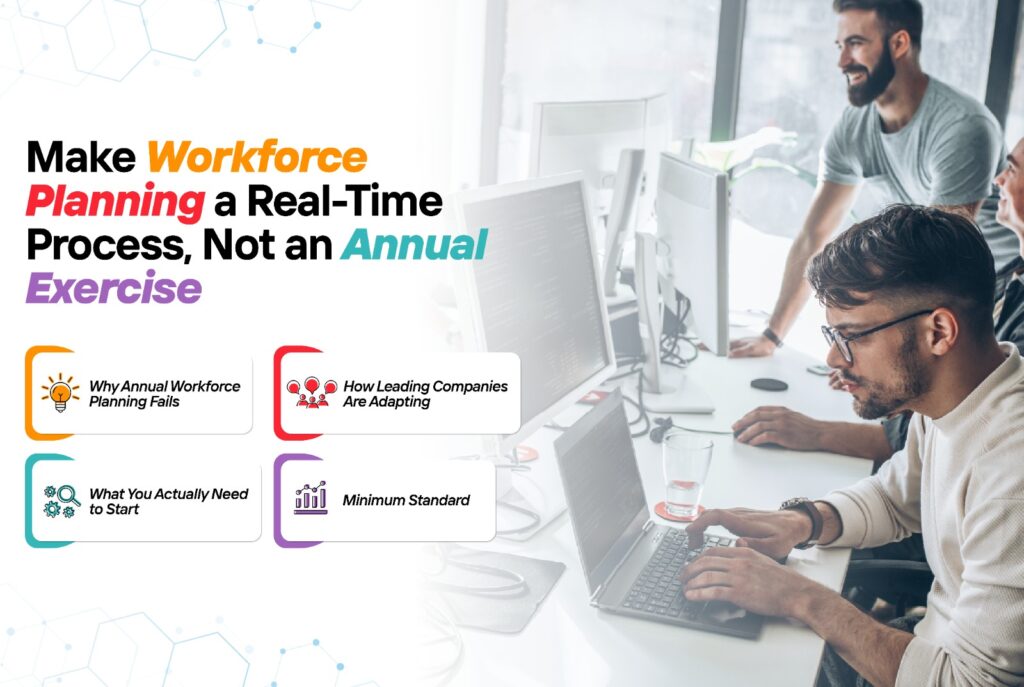
Why Annual Workforce Planning Fails
- Happens once a year, outdated almost immediately
- Pace of change in 2026 makes annual cycles structurally insufficient
How Leading Companies Are Adapting
- Using predictive analytics and AI to forecast talent needs
- Tracking recruitment patterns, turnover trends, performance data, and external labor markets
- Seeing capability gaps form before they become vacancies
What You Actually Need to Start
- Not sophisticated tech, just discipline
- Review workforce data more than once a year
- Connect reviews to real business decisions, not just HR reporting
Minimum Standard
- Workforce planning services and capability reviews: quarterly at minimum
- Real-time visibility into turnover risk by role category
- Track attrition patterns that signal where gaps are forming
Step 4: Build a Talent Strategy Around Skills, Not Just Roles
The move from credential-based to skills-based talent strategy is one of the biggest shifts happening in workforce planning right now.
Here’s why it matters:
- 53% of employees worry they don’t have the right skills for the future
- 63% would trade a 10% pay bump for the chance to upskill in AI and digital tools
That willingness is already sitting inside most workforces. The organizations winning are the ones making development visible, accessible, and tied to real career growth.
A skills-based strategy treats every talent decision- hiring, deployment, development, retention- as a skills question first. What does this person bring? What does the role need? Where’s the gap, and how do you close it?
Sounds simple. Actually doing it takes infrastructure most HR teams are still building. But the ones that build it are seeing better retention and better performance at the same time.
Step 5: Connect External Staffing Partners to Internal Workforce Planning
Most companies treat external staffing agencies as a reactive fix and internal workforce planning as a separate thing. The ones building future-ready workforces connect the two.
A staffing partner who knows the market can tell you where talent is available and how fast, for roles your internal pipeline can’t fill quickly enough. That intel should feed your workforce planning, not be something you scramble for after the plan falls apart.
Contract and project-based talent also lets you access specialized skills without long-term overhead. That matters when the need is real, but the timeline is uncertain.
Frequently Asked Questions
Q1: Where to start building a future-ready workforce?
With a skills gap analysis, not a job description. Map current skills against future needs. That gap tells you where to hire, develop, or bring in flexible staffing.
Q2: How is workforce planning different from headcount planning?
Headcount asks how many. Workforce planning asks whether you have the right skills, where gaps are, and how to close them. That’s the difference between staying ahead and always reacting.
Q3: How does Tekberry help with future-ready workforce solutions?
We connect strategy to execution, providing pre-vetted talent for roles your pipeline can’t fill fast enough. Contract or permanent, we stay through onboarding to make sure placements stick. Reach out; let’s figure out where you need support.
Key Takeaways
- Six in ten workers will need retraining before 2027, but only half have access to adequate training opportunities
- Strategic workforce planning is the second-highest HR priority globally but ranks fifteenth in actual capability; the gap between priority and execution is where most organizations lose ground
- Job rotation and internal mobility programs are highly effective but used by fewer than 25% of HR teams despite being available
- Skills-based talent strategies consistently outperform credential-based ones on both retention and organizational performance
- External staffing partners and internal workforce planning work best as connected systems, not separate functions
Conclusion
Getting your workforce ready for the future isn’t about flashy new tools or throwing money at training. It’s about whether you’re actually thinking ahead, connecting where your business is going with the people you’re bringing on today.
The strategies that really work pull together real data, skills-based growth, internal development, and outside support to cover what your own team can’t fill fast enough.
That approach helps you spot talent problems before they hit. It’s what separates the companies that are hiring smart in 2026 from the ones always playing catch-up.
Tekberry connects external talent to your internal workforce strategy. Reach out; let’s figure out where you need support right now.
Need the right talent for your team?
Partner with tekberry to access data-driven recruitment solutions that connect you with skilled professionals quickly and efficiently.
Book a Free Consultation