




There’s this open role on your tech team. Deadlines are breathing down your neck. Every week that chair stays empty? Yeah, that’s costing you.
You are about to post the job description or ping a recruiter, but stop for a second. Contract or direct hire? Considering what you really need is of utmost importance.
It messes with both your budget and your timeline. This is where Tekberry assists you. We will help you hire the best candidate for your tech company.
And that starts with knowing the difference between the two.
What’s the Actual Difference Between Contract and Direct Hire?
First things first, what do these actually look like in practice? Not on paper. For real.
Direct Hire Recruitment
Direct hire recruitment, or permanent placement, just means they’re a full-time employee right out of the gate. Your payroll. Your benefits. The employee you hire will follow your schedule and work at a fixed time for you.
The hiring process tends to be more thorough. More about building a real relationship. Both sides have a lot more to lose.
Contract Staffing
Contract staffing means engaging a professional for a defined period or specific project scope. Contract workers are typically employed through a staffing agency or as independent contractors. This engagement exists without the expectation of permanent employment.
They can often start within days rather than weeks, and there are no long-term compensation commitments like benefits or PTO.
Contract-to-Hire
There’s also a third model worth knowing: contract-to-hire. This hybrid lets both sides evaluate fit before making a full commitment.
The candidate works on contract for a set period, typically three to six months, with a mutual understanding that a full-time offer may follow.
Each model has its place, but let’s look at where the contract staffing agency really pulls ahead.
Contract Staffing Benefits in Tech
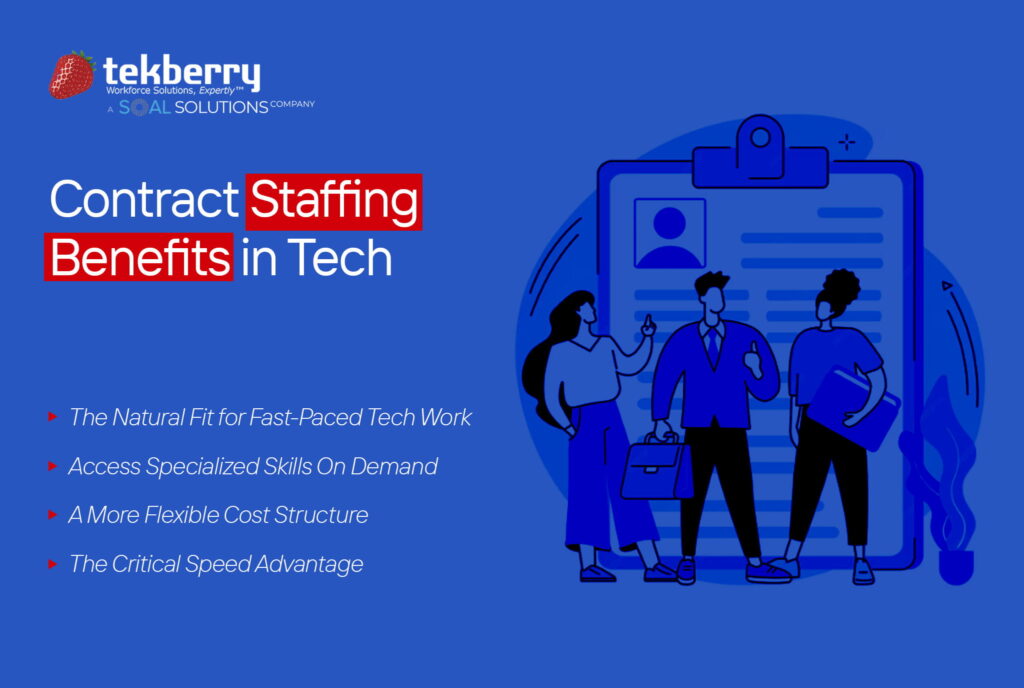
1. The Natural Fit for Fast-Paced Tech Work
Tech companies move fast. Product launches, infrastructure upgrades, security audits, and platform migrations are rarely indefinite efforts. They have start dates, end dates, and very specific skill requirements. Contract staffing is built exactly for this kind of work.
2. Access Specialized Skills On Demand
Contract staffing benefits include the ability to bring in expert skills exactly when you need them, whether that’s software development, cybersecurity, cloud architecture, or data science.
Contractors let you scale your workforce up or down without the long-term commitment of permanent hires, and they allow you to respond to fluctuating workloads or new project demands without the longer timelines involved in permanent hiring.
3. A More Flexible Cost Structure
The cost structure also works differently. You’re not carrying benefits, retirement contributions, or severance risk. For shorter engagements, this can make contract staffing significantly more budget-efficient, especially when your headcount approvals are project-based rather than fixed.
4. The Critical Speed Advantage
The speed advantage is real. When you need to fill a critical tech role yesterday, a well-connected tech staffing partner can find you pre-vetted, available candidates in days, not weeks.
Similarly, when it comes to direct hire, it has its own advantages.
The Case for Direct Hire Recruitment in Tech
Mutual Stability & Cultural Buy-In
Direct hire recruitment works both ways; it gives the company and the employee real job security and stability. Full-time people just tend to be more bought into the organization’s vision and values. This helps with long-term productivity.
The Overlooked Long-Term Cost Advantage
There’s also a retention and cost dynamic that gets overlooked in short-term budget conversations. While upfront recruitment costs and benefits may be higher with direct hire recruitment, the model often saves money over time.
It reduces turnover expenses and maintains consistent productivity with experienced, long-tenured staff.
Continuity as a Competitive Edge
For tech companies building proprietary products or maintaining complex systems, that continuity isn’t a nice-to-have; it’s a competitive advantage.
So both models bring real value; the question is, which one is right for your situation?
Contract vs Direct Hire: How to Choose the Right Staffing Model
The right staffing model isn’t about preference; it’s about the nature of the work itself. The biggest mistake hiring managers make? They just go with what they’ve always done. They don’t stop, step back, and ask themselves, what does this role actually need right now?
Here’s a straightforward way to think through it:
How long will this work last?
Ongoing, core functions point toward direct hire. Defined projects or seasonal spikes point toward a contract.
How fast do you need someone productive?
Urgent gaps favor contract staffing. Roles where a thorough search is worth the time favor direct hire recruitment.
How critical is cultural alignment?
The more a role is tied to team cohesion and company direction, the stronger the case for direct hire.
What does the budget structure look like?
Project-based or variable budgets favor a contract. Approved long-term headcount favors direct hire.
How much risk can you absorb?
Contract reduces commitment risk. Direct hire reduces continuity risk. Know which one matters more for this specific role.
Both the hiring models have their own pros and cons, and both carry their own costs.
FAQs
Q1: Is contract staffing more expensive than direct hire for tech roles?
Not necessarily. It honestly just depends on how long the work lasts and how big the scope is. Contract staffing usually means lower upfront costs and no benefits to worry about. That makes it a smarter fit for short-term or project-based needs, budget-wise, anyway.
Now, if you’ve got a role that’s probably going to hang around for more than 12 to 18 months? Then direct hire recruitment tends to be the better deal over time.
Q2: What’s the biggest risk of getting the staffing model decision wrong?
A staffing model mismatch is costly in both directions. Hiring a contractor for a role that needs deep institutional knowledge means spending more time onboarding and re-training than you ever saved by moving fast. Hiring a permanent employee for work that’s genuinely project-based means carrying long-term costs for a short-term need, and potentially a difficult separation when the project wraps.
Q3: Can Tekberry support both contract and direct hire placements?
Yes. Tekberry works across both staffing models, matching the right approach to the actual demands of the role. Whether you need someone in a seat within the week or want a thorough search for a key direct hire recruitment, we bring the same standard of vetting and market knowledge to both. Reach out to the Tekberry team to talk through what your current roles actually need.
In Sum
All in all, neither staffing model is inherently cheaper. Contract staffing can become expensive if projects run longer than planned, since higher rates are built for short-term, uncertain roles.
Direct hire carries the hidden cost of a bad early exit, including re-recruitment, lost productivity, and double onboarding. Ultimately, cost efficiency depends entirely on matching the staffing approach to the work’s true duration and nature.
Need the right talent for your team?
Partner with tekberry to access data-driven recruitment solutions that connect you with skilled professionals quickly and efficiently.
Book a Free Consultation